November 17, 2026
A colleague found out this week that I had done something new —something I was quietly proud of —and her first reaction wasn’t congratulations; it was that she was a little put out that I hadn’t told her. She was right to be. The reason I didn’t tell her is worth a newsletter all on its own.
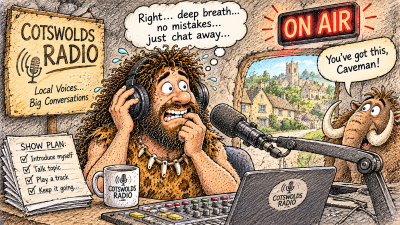
This caveman started a Saturday morning radio show last week. Breakfast with Carl, Cotswolds Radio, 7am to 10am, and I genuinely loved every minute of it.
Caroline Cavanagh, a speaker colleague whom I would have expected to be one of the first to know, found out after the fact and was, understandably, a little put out. Not in a dramatic way, but in the way people who care about what you do feel when they weren’t given the chance to support it. She was not wrong to feel that, and I was not wrong to do it the way I did, and understanding why both can be true at the same time is exactly what this newsletter is about.
The honest reason I said nothing before the first show is that if I told people, they would listen. If they listened, they would have an opinion. If I was terrible, that opinion would exist in people who matter to me, in people like Caroline, and I would have to live with that. So I said nothing, went in, did the show, and waited to see how it landed before I decided whether it was worth mentioning.
Warren, the official trainer at Cotswolds Radio, listened to the show and told me afterwards that he loved the content and the music choices. He had a few ideas for the next one, but overall he thought I had handled and managed the show well. That was the moment I allowed myself to be pleased.
Now I am telling you.
This is not a character flaw. It is ancient threat management, running exactly as it was designed to run, in a context it was never designed for. The caveman brain calculates risk by audience size. A hunt witnessed by the whole tribe, and then failed, carries a social cost that follows you. A hunt attempted quietly, and failed, costs you far less. So the brain, without being asked, reduces the audience before the attempt rather than after, to contain the downside before it has a chance to happen.
The problem is that this strategy, which was entirely rational in a world where reputation within a small group was the difference between being helped and being left behind, now creates a different kind of cost. The people who would have been in your corner do not get the chance to be there. The support that might have made the attempt feel less exposed doesn’t arrive because the attempt was invisible. You protect yourself from embarrassment, and you accidentally protect yourself from connection at the same time, and the two losses are not equal.
Caroline didn’t miss my radio show because she didn’t care. She missed it because I did not trust her with the possibility that it might go wrong, and that is a different thing entirely.
The caveman brain performs best when the stakes feel manageable. When the audience is small, expectations are low, and failure is survivable. The paradox is that the things worth doing rarely stay small, and the people worth having in your life are exactly the ones whose presence raises the stakes. Keeping them out of your early attempts protects the attempt, but it also keeps your tribe at arm’s length from the parts of you that are still figuring things out.
That is not protection. It is isolation with better intentions. What I am learning, slowly, in the way that this caveman learns most things, is that the right question before a new attempt is not “what happens if I fail in front of people?” It is “what do I lose by not letting people in?” The answer to the second question is almost always larger than the cost of the first.
If you have been keeping something quiet because you are not ready to let people watch you try, that is your caveman brain working perfectly. It is also worth asking who is missing the chance to support you, and whether the protection is worth the price.
If you want to hear the show for yourself, Breakfast with Carl is on Cotswolds Radio every Saturday from 7am, and you can follow along https://www.cotswoldsradio.com/ and if you like it perhaps you can follow me on Instagram @carlatbreakfast.
If you would like me to bring this conversation into your next event, meeting or training session, let me know. You can learn more at www.carljones.org, or book a 15- or 30-minute Teams call directly there.
Caveman Thought
The tribe did not cheer the hunter who trained alone. They cheered the one who brought them into the attempt. The kill mattered. The belonging mattered more.
Parting Question
What are you doing secretly right now that someone who cares about you would want to know about—and what are you protecting by not telling them?
As always, be the tribal member you are meant to be. It makes for a much easier and simpler life.
Your friend,
Carl – The Caveman.
P.S. When you are ready, here are a few things that might help you;
- You can book me to attend your next event as a Keynote Speaker.
- Want to take a FREE personality test? Check out The Caveman Principles Tribal Sorter.
- Check out my theories – The Caveman Principles and The SLAP Technique
- Grab a copy of my book The Caveman Principles, directly from my printing agent.
- You might want to sign up for one of my eLearning courses to help you master a new skill.
- Or, if you have time and want to schedule a Caveman chat (with virtual coffee) for a discovery call, do it here.