November 10, 2026
This week I caught myself doing the very thing I had just read about in the news. Not someone else doing it -Me! At my desk, in the middle of a Monday morning.
Today’s newsletter is about AI and the jobs it is surely going to affect, an experiment in the 1960s that nobody talks about anymore but everyone should know, and whether the film industry had seen the future. If you have fifteen minutes this week, this one might be an eye opener.
I read something this week about AI being developed not to assist human work, but to replace it, designed to generate revenue once it becomes reliable enough to remove humans from the loop. No wages, no sick leave, no complexity, no HR, no managers or leadership required. The commercial logic is clear, and the direction of travel is somewhat obvious (temperamental staff that are continually expensive or a robot you pay for just the once).
That would have been worrying enough on its own, but what made it more worrisome was that I looked at my screen and saw the slide. The AI tool was open and in use, doing a meaningful amount of my own heavy lifting. The searching, the structure, the trivial tasks, the thinking through of content, posting to socials and upgrading my website SEO. The very thing I had been reading about was already happening on my own screen. I didn’t need any additional resources, experts, or people to help me extend my working day (removing jobs from the list of contractors I would normally use).
A busy version of me could have shrugged that off and carried on. What I did was to stop, because that is what this whole Caveman Principles lens is. Take the one obvious uncomfortable thing and ask ourselves to listen to what it is trying to tell us, rather than explain it later, maybe after we’ve killed off the SEO expert industry. The answer was that I was no better than the corporate looking to replace its workforce as quickly as I can. I am using the same logic, I had just not examined it until now.
Sat there, I remembered reading a book called Stolen Focus by Johann Hari and he mentioned Universe 25.
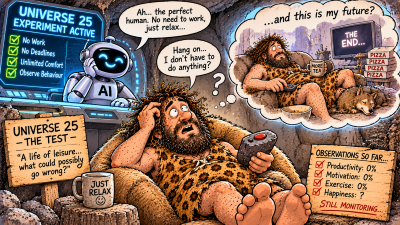
In the 1960s and 1970s, a scientist named John Calhoun built what he called a mouse utopia. Unlimited food, water, space, no predators, no disease, no need to compete or contribute or work for anything, everything was provided. I say that again, everything was provided. The population boomed at first, as expected. Then something strange started to happen. The mice stopped interacting as they should. Social bonds broke down, some became hyper-aggressive, others completely passive. Groups of males withdrew entirely from social life and spent their days grooming themselves, eating, and did nothing of use. Reproduction slowed and then stopped. The population collapsed and eventually died out, all in a set of conditions that were considered by every physical measure, perfect.
Calhoun called it a behavioural sink. When there is nothing left to contribute towards and nothing expected from each other, the social fabric does not relax. It unravels and diminishes.
If you look at all the films that have been made and are being produced. Terminator. RoboCop. AI. I-Robot. The list goes on, and the stories keep coming, generation after generation, through different technologies and different directors, albeit different decades. This is not a coincidence, and it cannot be just simple entertainment. This is the tribe’s oldest instinct at work: the campfire story, warning the people around it about the predator in the dark. We have been telling ourselves this same warning for forty years on cinema screens. The question is whether we are actually listening or wanting to give up everything without thinking of the consequences.
The caveman understood something that the modern world has gradually dumped from daily life: purpose is not a luxury. It is a biological requirement. Every member of the tribe contributed something real, because the alternative was death. The contribution was the meaning that made it all worthwhile. Take the contribution away, and you do not get leisure, you get Universe 25.
I am not saying AI is bad. I use it, you probably do as well, and that is not the problem. The problem is using it in a way that gradually hollows out what makes us worth something as humans and to the people around us. The question worth asking is not whether AI can do what you do. It is what is left when it does, and whether that is enough to build a life into the future.
If you are a Hunter
The Hunter’s entire identity is built around the chase. The goal, the pursuit, the moment of an achievement — that is where the Hunter feels alive. Take the hunt away and hand it to a machine that does it faster and more efficiently, and the Hunter does not gratefully retire. The Hunter becomes restless, reckless, looking for something to chase even when there is nothing worth chasing. The danger for the Hunter in an AI world is not becoming obsolete, it is the directionless wander that burns enormous amounts of energy and goes nowhere. The question for the Hunter is not whether AI can do the job, it is what hunt would be worth doing that AI can’t. The more complex, the more human focused work, the trickier relationship management, the difficult (humane) judgment calls, the work that requires someone who actually cares about the outcome, can they copy that?
Stay in the hunt. Just make sure you are hunting (success) that is real.
If you are a Protector
The Protector is fuelled by being needed, by the knowledge that the people around them are safer and steadier because they showed up. If AI gradually removes the threats the Protector was guarding against, the Protector does not feel relieved. They feel lost and redundant, and the loss hits at the identity level, not just a professional one. The recalibration for the Protector is to ask what protection means in a world where machines handle more of the technical risk. The answer is almost certainly that the human dimension of protection, the emotional safety, the trust, the knowing someone has your back when it is not a machine problem, this becomes more valuable, not less.
You cannot be replaced in the room, make sure you are in the room.
If you are a Gatherer
The Gatherer’s edge has always been information: finding it, synthesising it, knowing which piece matters and when to use it. AI processes information faster than any human alive, and that is a genuine challenge for any Gatherer who has built their identity on being the one who knows everything. The pivot available to the Gatherer is from information to wisdom, and that is a pivot worth making sooner, because wisdom is not data processing. It is knowing what the data means for real people in real situations, with judgment and experience into context that no model currently has. The Gatherers who thrive will be the ones who stop competing on volume of knowledge and start competing on depth of understanding.
Collect less. Understand more, this gap will be real and will be yours.
If you are a Healer
Of all four types, the Healer may be the most unaffected in an AI future, and the most important. The thing the Healer offers is genuine human connection, the ability to offer how being truly understood by another person is not something any model can replicate, however well it is trained. People know the difference between a conversation that processes their feelings and a conversation that actually reaches them. The challenge for the Healer is not uselessness, it is being drowned out by the sheer volume of AI-generated content, advice and fake support, to the point where people stop looking for the real thing because they have forgotten what it feels like.
The connection you offer cannot be downloaded. Don’t let people forget it exists.
The films were right to warn us, if you look more carefully at what they actually show: the humans who survive are never the ones who try to out-compete the machines. They are the ones who remember what makes them human, who hold onto relationships as well as the purpose and the meaning that no machine could ever be designed to replicate. Universe 25 collapsed because the mice no longer had a reason to need each other. That is the thing worth protecting above everything else: our need for each other, our contribution to something larger than ourselves, the tribe.
Stop, reassess and understand your position. Use the tools deliberately and keep them in their place. The hope is not that AI fails, it is for the hope is that we remember what we are for.
If you want to know what Tribe you belong to, take the free Tribal Sorter to find out which personality type you are: https://cavemanprinciples.com/#quiz
If your team is navigating the anxiety and uncertainty that comes with AI changing the nature of their work, understanding how your people are wired, what gives them purpose, and what they need in order to feel valuable is not a silly, menial thing. It is the difference between a team that adapts and one that starts to unravel. That is exactly the kind of conversation I help organisations have.
Find out more: www.carljones.org
If you would like me to bring this conversation into your next event, meeting or training session, let me know.
Book in for a 15 or 30 min Teams call to find out more about my keynotes here: caveman/discovery
Caveman Thought
The tribe did not need the fastest hunter. It needed a hunter who cared whether the tribe ate tonight. Speed can be replaced. Care cannot. In a world where machines do more and more of the doing, the question worth asking is not whether you can be replaced, but whether you have made yourself irreplaceable in the way that matters. Do it the human way.
Parting Question
If AI did everything you currently do at work tomorrow, fully competently and without you, what would be left to do? What would still need a human touch, a specific human, you, in that role? Your answer to that question that you need to ask yourself is whether it is honestly or defensively answered, because the answer is not a threat. It is a map. It shows you exactly where to put your energy next.
As always, tend your own fire first. It is the one that actually warms the people around you.
Your friend,
Carl – The Caveman.
P.S. When you are ready, here are a few things that might help you;
- You can book me to attend your next event as a Keynote Speaker.
- Want to take a FREE personality test? Check out The Caveman Principles Tribal Sorter.
- Check out my theories – The Caveman Principles and The SLAP Technique
- Grab a copy of my book The Caveman Principles, directly from my printing agent.
- You might want to sign up for one of my eLearning courses to help you master a new skill.
- Or, if you have time and want to schedule a Caveman chat (with virtual coffee) for a discovery call, do it here.